
Queensland Police
Transforming law enforcement
The bail app for QLD Police Service.
Overview
Widely regarded as leaders in adopting innovative methods such as field DNA sampling and digital community engagement using social media, the Queensland Police Service (QPS) sought to improve the in-person bail reporting process to save time and streamline processes.
Challenge
200+ police stations, 2,000-4,000 bailees reporting weekly, an entirely paper-based system and zero central visibility.
QPS required a process that made bail grant and bailee reporting easier, quicker, safer, and more efficient and traceable for the people of Queensland. They also wanted this process to offer greater flexibility and convenience for officers handling bail seekers, bailees, and their respective cases.
Prior to the project, QPS had been using a complex system of paper-based forms for bail and related procedures. After submitting their bail grant application, the applicant – who could be an offender – may have to go to a police station for an update or for a general query. And as bailees could report themselves to any station in the state, tracing them was a tedious and time-consuming process.
Loss of productivity and extended processing times were not helping the officers as they could potentially use their valuable time for catching offenders, saving lives, and engaging with the community.
Solution
Human-centred design to develop a new digital platform
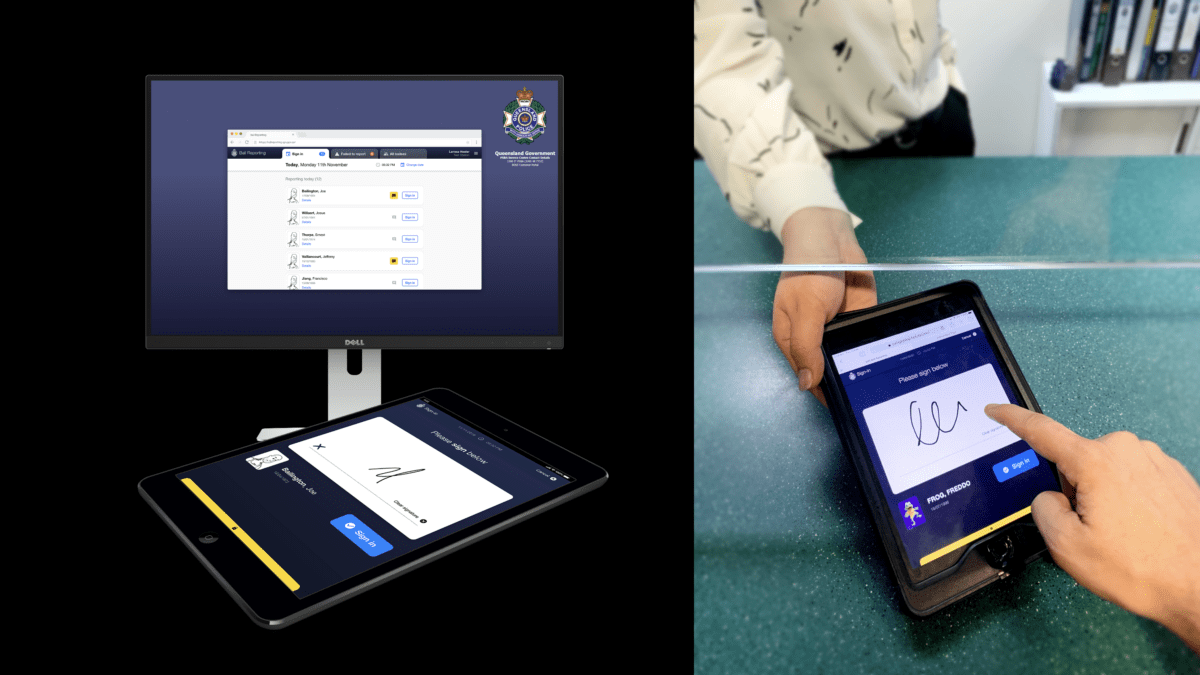
Using human-centred design techniques, the QPS MCC team and Versent (formally known as Telstra Purple) developed a platform via the agile software development framework, which was then installed on iPads provided to QPS officers and desktops in stations.
With this new digitised process, officers can capture or trace breaches, bailees reporting at a different station, changes in bail conditions, and verify the identity of a bailee or an offender from the convenience of their iPads or desktop computers. ]
The approach
Collaborative innovation
Using multiple workshops and interviews, Versent worked with QPS to understand what was working, what still had value and needed to be retained, and where improvements could be made.
We surveyed 250+ officers, visited stations and ran prototypes at certain locations. Officers shaped the solution, ensuring the result was something they wanted to adopt and saw value in.
The impact
Streamlined operations across the state
After a 4-month rollout, every police station in Queensland was cost-effectively equipped with the solution using their existing IT infrastructure.
The digital bail reporting solution streamlined operations, with every station in the state following the same digital process, reducing the chance of duplicity or manual error. It also ensured the privacy and safety of people at the station reporting an offence as the bailee-police communication happens away from them.
With the implementation of this solution, the QPS became the first agency in the country to digitise the bail reporting process, thus promising a flexible, transparent and safer environment for the people of Queensland. As laws and procedures regarding young offenders are different, the QPS and Versent followed up this successful solution with a similar one for youth bail reporting.
This digital interaction has helped QPS to build trust and provide an improved experience for its community:
- Smarter reporting. Bailees can report to stations more efficiently, and sign in using iPads. Stations know who to expect, and their reporting conditions without the need for extra administrative work, and instantly know if someone has failed to report.
- Reduced processing time. With unique identities and case numbers, the officers can retrieve the information they need instantly and securely. Any breaches, changes in bail conditions, bail reporting at a different station, and bailee verification are processed and updated through the digital system.
- Greater flexibility. Searching for the historical records of offenders, their movements between areas of jurisdictions, if any, and other changes can be accessed conveniently right at the officers’ fingertips.
Breach reports: 90 min → 5 min
Failure-to-report detection: 48 hrs → Instant
Station transfers: Days → 30 min
Scale: 3 stations → 200+ in 4 months
The digital bail system, first deployed in 2019 is still running and still evolving.